The Flow Lamp was developed by James Wilson during his graduate studies in music composition at the Boston University School of Fine Arts. The original intent of the device was to provide a visual analogue to the subtle sense of “flow” experienced in music performance, particularly within the context of jazz improvisation. Drawing on this experiential foundation, the Flow Lamp presents a continuously moving line that oscillates slowly and smoothly in a manner analogous to the phases of a sine wave, emphasizing continuity, gradual transition, and cyclical balance.
Several years after the construction of the initial prototype, the Flow Lamp was incorporated as the central stimulus in a controlled biofeedback study conducted at Nova Southeastern University in Davie, Florida. The experiment involved 47 participants and employed a well-defined experimental design in which physiological stressors were introduced at regular intervals. Participants exposed to the Flow Lamp demonstrated statistically significant improvements in recovery time following these stressors when compared with a control group.
These findings suggest that sustained exposure to the Flow Lamp’s visual dynamics may facilitate more efficient autonomic regulation under stress.
One proposed interpretation of these results is that the Flow Lamp preferentially engages right-hemisphere modes of processing—such as holistic perception, temporal continuity, and non-verbal pattern recognition—which may in turn reduce excessive left-hemisphere dominance associated with analytical, effortful control. By supporting right-hemisphere engagement, the device may indirectly allow the left hemisphere to engage in more persistent stress reduction activity, thereby enabling more effective recovery processes.
This interpretive framework aligns with the work of Dr. Iain McGilchrist, British psychiatrist, neuroscientist, and author of The Master and His Emissary. McGilchrist has argued that many negative features of contemporary Western culture reflect an imbalance between the cerebral hemispheres, characterized by an over-dominant left hemisphere operating without adequate regulation from the right.
Within this context, the Flow Lamp can be understood as an applied, perceptual intervention that seeks to restore experiential balance by reintroducing slow, continuous, and non-instrumental forms of attention associated with right-hemisphere functioning
Rising Sun
Flow Lamp
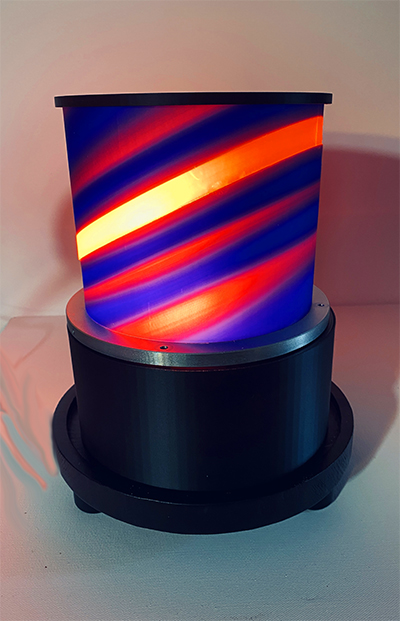
Specifications
Model Category: Desktop
Model Name: Rising Sun
Dimensions: 10 x 10 x 12 inches (l x w x h)
Cylinder/Main Body Color: Blue, Red
Cylinder Material: plastic
Trim: Aluminum
Lighting: Recommended:
- LED A21 Red Light Bulb – 15W (120W Equivalent), E26 Base, 1200 Lumen . Red bulb recommended. Available at Amazon
Bulbs are not included.
Rotation Speed: This model revolves at 1.2 RPM.
Instruction Manual: Includes rotation speed setting chart: rotation speed by music tempo.
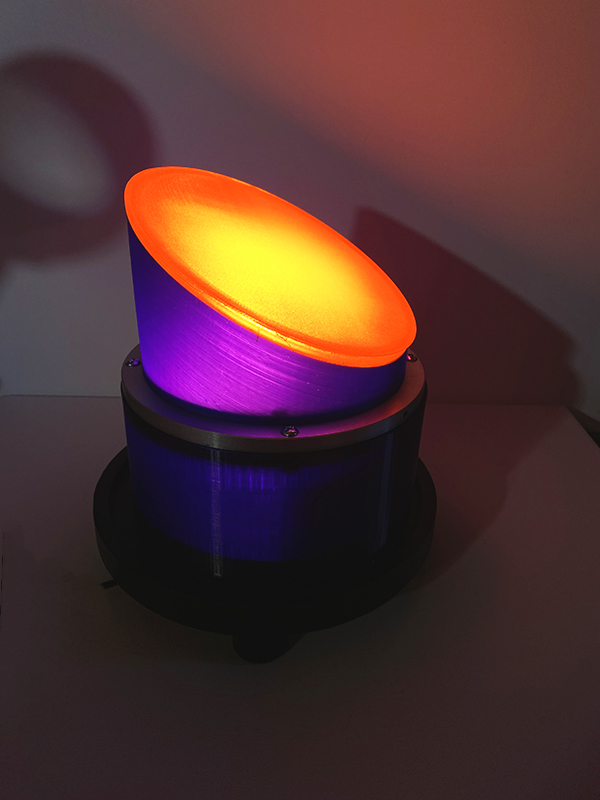
Solaris
Flow Lamp
Specifications
Model Category: Desktop
Model Name: Solaris
Dimensions: 10 x 10 x 12 inches (l x w x h)
Cylinder/Main Body Color: Blue with a orange face
Cylinder Material: plastic
Trim: Aluminum
Lighting: Recommended:
- LED A21 Red Light Bulb – 15W (120W Equivalent), E26 Base, 1200 Lumen . Red bulb recommended. The red bulb in combo with the blue semi-transparent cylinder wrapping provides a very unusual and pleasant purple glow. Available at Amazon
Bulbs are not included.
Rotation Speed: This model revolves at 1.2 RPM.
Instruction Manual: Includes rotation speed setting chart: rotation speed by music tempo.